


If you’ve been searching for the “best LLM for coding”, you’ve probably seen a dozen different answers and most of them contradict each other.
Here’s the truth:
There isn’t one single best model. There’s only the best model for your kind of work.
This guide breaks it down in a practical, human way no hype, no fluff.
The Top Coding LLMs Right Now
1. Anthropic – Claude Opus (5.x trajectory)
Claude Opus is what you use when things get messy.
It doesn’t just generate code it understands structure, dependencies, and intent better than most models right now. If you’re dealing with a large codebase or debugging something painful, this is where it shines.
Best for:
- Debugging complex systems
- Understanding large repositories
- Writing clean, maintainable code
Reality check:
It’s expensive. You don’t want to use it for everything.
2. GLM-5.1 (Open-weight contender)
GLM-5.1 is the model that’s quietly disrupting everything.
It’s not quite as smart as Claude Opus in edge cases but it’s close enough that for most coding tasks, you won’t notice the difference. And it’s significantly cheaper.
Best for:
- Daily coding tasks
- Rapid iteration
- Building products at scale
Reality check:
It can struggle with highly complex reasoning or unusual bugs.
3. OpenAI – GPT-5 (Code capabilities)
GPT-5 is less about writing code line-by-line and more about thinking through systems.
It’s strong at planning architectures, designing workflows, and powering coding agents that actually execute tasks.
Best for:
- System design
- AI coding agents
- Multi-step problem solving
Reality check:
Overkill for simple coding tasks.
4. Google DeepMind – Gemini (Code models)
Gemini focuses on speed and integration.
If you’re working inside an IDE or building something interactive, it feels fast and responsive. It’s not the deepest thinker but it’s efficient.
Best for:
- Frontend work
- Real-time coding assistance
- Developer workflows
Reality check:
Not the strongest at deep debugging.
So… Which One Is Actually “Best”?
Let’s simplify it.
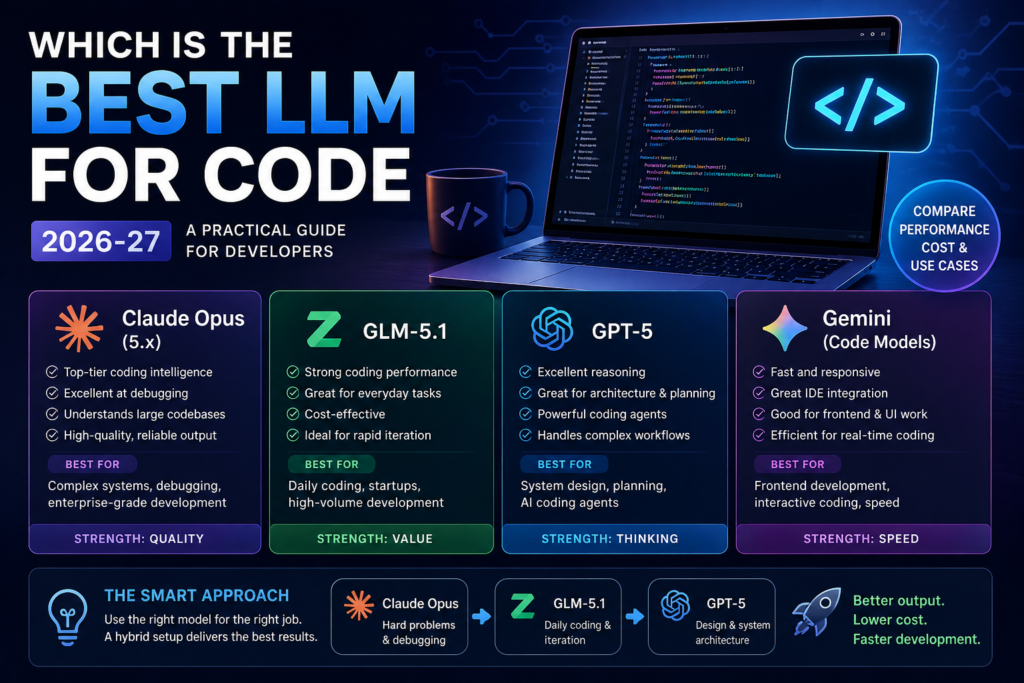
- Best for pure coding intelligence: Claude Opus
- Best for cost and everyday use: GLM-5.1
- Best for planning and systems: GPT-5
- Best for speed and workflow: Gemini
If you force a single answer, Claude Opus still edges ahead but that’s not how smart teams work.
What Most Developers Get Wrong
A lot of people try to pick one model and use it for everything.
That doesn’t work anymore.
Different models are good at different layers of development:
- One writes code fast
- One debugs better
- One designs systems
If you rely on just one, you’re limiting yourself.
The Smarter Approach (What Actually Works)
The best setup in 2026–2027 isn’t a single LLM it’s a combination:
- Use Claude Opus for hard problems and debugging
- Use GLM-5.1 for everyday coding and scale
- Use GPT-5 when you need architectural thinking
This hybrid approach gives you:
- Better output
- Lower cost
- Faster development cycles
What’s Changing Going Into 2027
Coding with AI is shifting fast.
We’re moving from:
- “AI helps you write code”
To:
- “AI builds and tests systems with you”
The biggest changes coming:
- Full repo awareness (models understand entire projects)
- Autonomous coding agents
- Built-in testing and iteration loops
The “best LLM” will matter less than how you use it.
Final Take
If you’re looking for a simple answer:
- Claude Opus → smartest
- GLM-5.1 → most practical
- GPT-5 → best thinker
But the real answer is this:
The best LLM for coding in 2026–2027 isn’t a model.
It’s a setup.